Facts checked Article
Casino cardroom culture
A slow roll is a conduct question before it is a penalty
Compare 888poker’s etiquette writing with its house rules, then separate an observed online delay from an allegation of deliberate humiliation or cheating.
The short answer needs the room’s policy
Slow rolling is described as poor etiquette in the 888poker material reviewed here. That does not establish one universal penalty across online poker rooms. Nor does the absence of a clause using those exact words prove that a room can never act: 888poker’s house rules include a broader fair-play policy addressing unethical conduct.
The useful answer to “is slow rolling against the rules?” therefore has two parts. Identify what happened, then identify the policy the room says applies. A delayed reveal, a pause before a decision, a false statement and a suspected coordinated action are not automatically the same conduct.
This article compares one operator’s public etiquette material with its published house rules and the Gambling Commission’s remote standard on collusion and cheating. It is not a review of the operator, a finding against a player or a record of an enforcement decision. No account or poker client was used.
The value is in making the difference between a social judgement and an enforceable policy visible before making an accusation.
Sources: What is Slow Rolling in Poker? and Why it’s Bad (With Videos); 888poker House Rules; RTS 11 – Limiting collusion and cheating.
Describe the act before using the label
888poker’s article gives several uses of “slow roll”: an intentional prolonged pause before calling with an extremely strong hand, delaying the reveal of a winning hand, and misrepresenting a hand before revealing the winner. These descriptions combine an observable event with an interpretation of intention.
An online spectator may observe that a decision took time. They do not thereby know whether the player understood the hand immediately or why the delay occurred. The same operator’s article acknowledges that attention may be divided across online tables.
Its house-rule etiquette section also recognises internet lag. Those are reasons to avoid treating elapsed time as a complete account of someone’s motive.
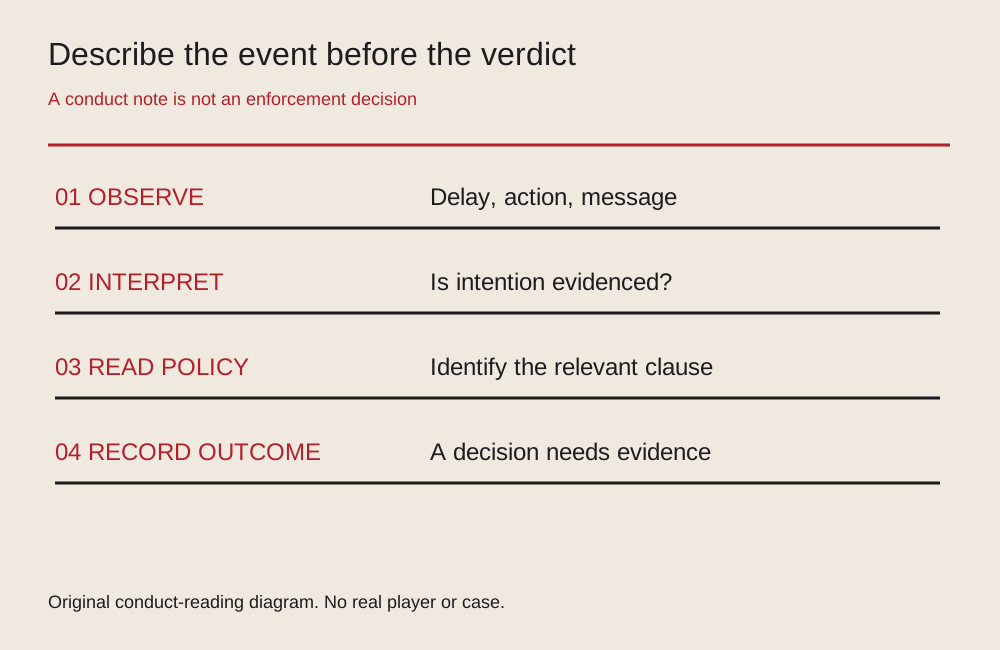
For an incident note, start with a plain sequence: the action was pending; the display remained unchanged; the player acted; the result appeared. Add only the messages or actions actually observed. “The player intended to humiliate me” is a conclusion requiring more evidence, not a substitute for that sequence.
The editorial distinction is not an excuse for deliberate discourtesy. It is a way to discuss conduct accurately in a setting where another person’s attention and connection are not directly visible. A good description leaves space for an explanation without denying what was seen.
Sources: What is Slow Rolling in Poker? and Why it’s Bad (With Videos); 888poker House Rules.
Incident note: the plain sequence
An online delay establishes elapsed time, not by itself a player’s intention. The operator’s own material recognises divided attention across tables and internet lag.
Ticks are kept only in this browser and are never sent anywhere.
An etiquette article is evidence of advice
The operator’s separate list of unwritten etiquette rules places slow rolling in a discussion of manners alongside other table behaviours. That establishes the advice the publisher gives its readers. It does not turn every sentence in a magazine list into a clause with a fixed sanction.
Compare the document types before comparing their conclusions. The strategy or etiquette article addresses how players should behave. The house-rules page sets out policies for the service.
The regulatory standard addresses measures operators must implement. A sentence can be forceful without acquiring the same authority as a provision in another document.
A reader checking a reported incident can therefore keep three headings in a notebook: advice, room policy and regulatory requirement. Under each, record the exact source and date. Leave a heading empty if no relevant text was found.
Filling that empty space with “everyone knows” would weaken the evidence.
This document comparison is particularly useful for slow rolling because social disapproval can be intense. Strong disapproval does not supply the missing policy wording. Equally, a technical argument that a magazine article is not a rule does not remove the broader fair-play obligations a room actually publishes.
Both questions need to remain in view.
Sources: Poker Etiquette – 30 Unwritten Rules Everyone Needs To Follow.
The fair-play clause prevents an absolute answer
888poker’s house rules say ethical play is expected and describe serious consequences for unethical play or breaches of stated or unstated rules. The same page separately prohibits collusion through sharing cards or other information to gain an unfair advantage. It also addresses intimidation and harassment in table etiquette.
These are materially different provisions. The broad fair-play clause means this review cannot safely promise that any action not named “slow rolling” is immune from sanction. The collusion clause, meanwhile, does not make every rude act evidence of cooperation between players.
The policy must be matched to the alleged behaviour.
A careful comparison row therefore reads: slow rolling, criticised in etiquette material; specific slow-roll penalty, not established by this review; broader conduct policy, present in the house rules. That formulation is less dramatic than “banned” or “allowed”, but it tells a reader exactly what was found.
We have not examined private terms for a particular account, an operator investigation or a sanction record. The public English-language pages are documentary evidence with that limited scope. They do not justify a prediction about how the room would decide an individual case, let alone how another operator would apply its own policy.
Sources: 888poker House Rules.
Convention or rule: the comparison row
- Slow rolling
- Criticised as poor etiquette in 888poker’s material, which gives several uses of the term, from a prolonged pause before calling to misrepresenting a hand before the reveal.What is Slow Rolling in Poker? and Why it’s Bad (With Videos) · as checked on
- Specific slow-roll penalty
- Not established by this review. The absence of a clause using those exact words does not prove that a room can never act.888poker House Rules · as checked on
- Broader conduct policy
- Present in the house rules: ethical play is expected, with serious consequences described for unethical play or breaches of stated or unstated rules.888poker House Rules · as checked on
- Collusion
- Separately prohibited: sharing cards or other information to gain an unfair advantage. The clause does not make every rude act evidence of cooperation between players.888poker House Rules · as checked on
- Intimidation and harassment
- Addressed in the house rules’ table etiquette section, as a provision distinct from the fair-play clause and the collusion clause.888poker House Rules · as checked on
Public English-language pages only. We have not examined private terms for a particular account, an operator investigation or a sanction record.
Three fictional incidents, three different records
First, imagine an online player takes several seconds to act and then shows the strongest hand at showdown. There is no accompanying message. The record establishes a delay and the eventual hand.
It does not establish whether the player knew the result immediately, had another task open or experienced a connection problem. Calling this a proven deliberate slow roll would add facts not in the example.
Second, imagine a player sends an explicit message saying they are waiting to upset their opponent, then delays the reveal. That supplies additional evidence relevant to intention. Keep the message and hand reference in a private report to the room.
It still does not supply an automatic penalty: the applicable policy and the room’s assessment remain separate questions.
Third, imagine two players exchange information about their concealed cards during a hand. That is a different concern from delaying a reveal. It raises the kind of information-sharing issue addressed by the operator’s non-collusion policy.
The report should describe the observed exchange rather than use “slow roll” as a catch-all term for conduct that felt unfair.
| Invented observation | Supported description | Not established |
|---|---|---|
| Pause, no message | Delay before action or reveal | Deliberate humiliation |
| Message declaring intention plus delay | Evidence relevant to intention | Automatic penalty |
| Players exchange concealed-card information | Possible information-sharing concern | Concluded cheating investigation |
Three evidence levels: a description, not a scale of guilt
Our comparison has three evidence levels: unexplained delay; delay with evidence of intention; possible information-sharing between players. It is not a scale of proven guilt. The point is to keep the description specific enough for an appropriate review.
All three incidents are invented. No participant, account, tournament or enforcement outcome is represented. Their usefulness lies in showing which new fact changes the question being asked, rather than rehearsing how to provoke someone at a table.
Three evidence levels
Not a scale of proven guilt. The point is to keep the description specific enough for an appropriate review.
Ticks are kept only in this browser and are never sent anywhere.
Cheating reports belong with the operator’s investigation process
The Commission’s RTS 11 requires measures intended to deter, prevent and detect collusion and cheating, along with relevant records for investigation. Its guidance says complaints about cheating should be investigated. It also requires information about the operator’s policies, recovered funds and how customers can report suspected cheating.
That framework gives a report a purpose beyond arguing in chat. A hand reference, the relevant actions and the exact message can help identify an event. They do not require a public accusation or a claim that the reporter has already proved coordination.
The operator has access to records that a reader of a single hand may not have.
Our suggested report structure is simple: identify the event, distinguish direct observation from inference, and state which conduct concerns you. If a message is quoted, reproduce it accurately through the operator’s appropriate private route. Do not circulate another player’s private information or create an edited public clip that hides the surrounding sequence.
The standard does not let this publication adjudicate the allegation. Its investigation requirements should not be recast as a promise that every report results in an account closure or compensation. Acknowledgement, investigation and an outcome are distinct stages.
The incident remains alleged until the relevant evidence supports a conclusion.
Sources: RTS 11 – Limiting collusion and cheating.
How to report suspected cheating to the room
The report structure the prose above suggests, in order. It gives a report a purpose beyond arguing in chat.
Identify the event
Give the hand reference, the relevant actions and the exact message. These help the operator find an event in records that a reader of a single hand may not have.
Separate observation from inference
State what you saw, then what you infer from it, as two different things. A report does not require a claim that you have already proved coordination.
State which conduct concerns you
Name the behaviour: a delay, a message declaring intention, or an exchange of concealed-card information. Do not use slow roll as a catch-all term.
Quote accurately, through the private route
If a message is quoted, reproduce it accurately through the operator’s appropriate private route. Do not circulate another player’s private information or an edited public clip that hides the surrounding sequence.
What the result means
Acknowledgement, investigation and an outcome are distinct stages. RTS 11 guidance says complaints about cheating should be investigated; it is not a promise of an account closure or compensation, and the incident remains alleged until the evidence supports a conclusion.
Courtesy does not require another hand
The conduct question is easier to handle when it is separated from the pressure of the next decision. Our editorial advice is to avoid retaliatory messages, describe any concern calmly and use the room’s published process. A feeling of being insulted is not a reason to increase stakes, extend a session or try to recover money from the same opponent.
It can also help to use narrower language in an ordinary conversation. “There was a long pause before the reveal” describes an observation. “I think the message suggests the delay was deliberate” labels an inference.
“The room found a breach” requires an actual decision. Those sentences should not be substituted for one another.
A reply to a courtesy complaint need not become a confession to a rule breach. An adult who was distracted can explain that briefly without debating every slang definition. Equally, someone reporting a pattern can preserve the relevant examples without turning the table into a public hearing.
The strongest conclusion this document comparison supports is deliberately limited. Slow rolling is criticised as bad manners in the operator’s guidance; broader conduct rules mean a blanket claim of immunity would be unsound; and an observed delay alone does not prove intention or cheating.
Read the room’s policy, preserve the distinction between evidence and interpretation, and leave adjudication to the appropriate process.
The vocabulary desk
- Slow roll
- Deliberately delaying a call or the reveal of a winning hand; the term joins an observed delay to a claim about intention.
- Fair-play clause
- A broad house-rule provision that expects ethical play and describes consequences for unethical conduct, whether or not the conduct is named.
- Collusion
- Players sharing cards or other information to gain an unfair advantage; a separate provision from table etiquette.
- RTS 11
- The Gambling Commission’s remote technical standard on limiting collusion and cheating; its guidance says cheating complaints should be investigated.
- Showdown
- The point at which the remaining players reveal their hands to decide the pot.
- Hand reference
- The identifier the room gives a hand, which lets a report point at one event rather than a general complaint.
Questions answered
Is slow rolling against the rules?
There is no universal penalty established by these sources. 888poker criticises it in etiquette material and publishes a broader fair-play policy, so neither “always banned” nor “always permitted” is a supported general answer.
Does a slow online decision prove a deliberate slow roll?
No. A delay is observable; motive needs more evidence. The operator material acknowledges divided online attention and internet lag as relevant possibilities.
Is an etiquette article the same as a poker room’s rules?
No. It establishes the publisher’s advice, while the room’s policy must be read separately. Strong wording in a magazine article does not establish a particular sanction.
Is slow rolling the same as collusion?
No. The house rules reviewed describe collusion in terms of players sharing information for an unfair advantage. A discourteous delay does not by itself establish that behaviour.
What should I include when reporting suspected cheating?
Follow the operator’s published route and give the hand reference, relevant sequence and accurately recorded messages. Separate what you observed from what you infer; this article does not determine whether a breach occurred.
What should an incident note record?
Start with the plain sequence: the action was pending, the display remained unchanged, the player acted and the result appeared. Add only the messages or actions actually observed.
Does every cheating report end in an account closure?
No. The investigation requirements in RTS 11 are not a promise of an account closure or compensation. Acknowledgement, investigation and an outcome are distinct stages.
References
Continue reading

What is slow rolling poker: what the posted rules say and what players merely expect
A slow roll is delaying the reveal of a winning hand at showdown after an opponent has shown. The 888poker etiquette guide calls it 'highly unethical'; the 888poker house rules and the 2026 World Series of Poker tournament rules do not name it at all. This piece reads all three, separates the slow roll from ordinary slow play, and sorts each behaviour into rule or convention.
Read What is slow rolling poker: what the posted rules say and what players merely expect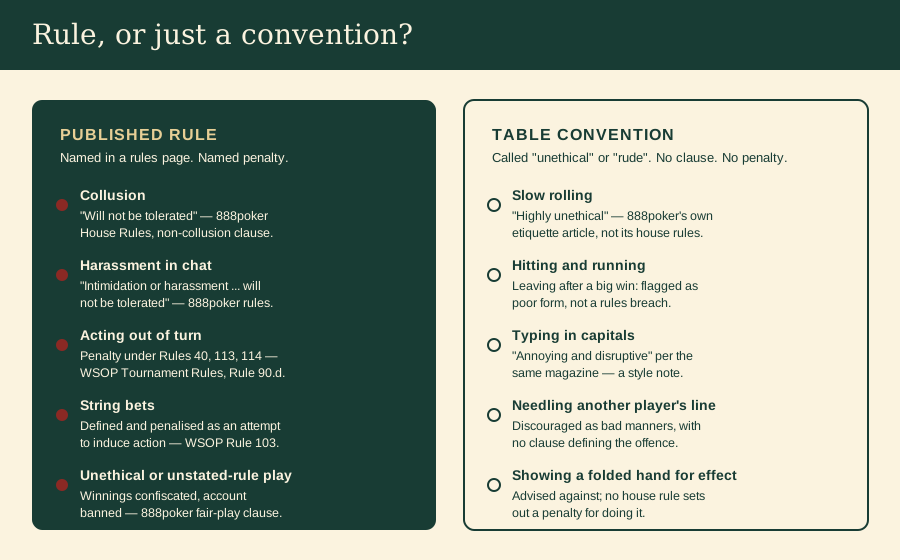
Online poker etiquette is not written down
A house rules page and a "poker etiquette" article usually sit on the same operator's own site. Read side by side, they draw a clear line between what gets you banned and what just gets you disliked.
Read Online poker etiquette is not written down
A casino deck is a working object
Card stock, finish and cutting matter as much as the illustration on the back. One maker publishes 3 sizes and up to 12 quality controls per card.
Read A casino deck is a working object
Why a cardroom keeps chips in view
An orderly chip stack helps a casino poker table remain legible to players, dealers and staff.
Read Why a cardroom keeps chips in view
The posted rules belong to the table
A familiar game name does not remove the need for a clear explanation of the version in front of you.
Read The posted rules belong to the table
Leaving a poker table and returning with less money are different decisions
Five PokerStars help pages separate leaving after a win, same-table returns, buy-in obligations and Seat Me, with their scope differences kept visible.
Read Leaving a poker table and returning with less money are different decisions
Continue reading
What is slow rolling poker: what the posted rules say and what players merely expect
A slow roll is delaying the reveal of a winning hand at showdown after an opponent has shown. The 888poker etiquette guide calls it 'highly unethical'; the 888poker house rules and the 2026 World Series of Poker tournament rules do not name it at all. This piece reads all three, separates the slow roll from ordinary slow play, and sorts each behaviour into rule or convention.
Read What is slow rolling poker: what the posted rules say and what players merely expectOnline poker etiquette is not written down
A house rules page and a "poker etiquette" article usually sit on the same operator's own site. Read side by side, they draw a clear line between what gets you banned and what just gets you disliked.
Read Online poker etiquette is not written downLeaving a poker table and returning with less money are different decisions
Five PokerStars help pages separate leaving after a win, same-table returns, buy-in obligations and Seat Me, with their scope differences kept visible.
Read Leaving a poker table and returning with less money are different decisionsA casino deck is a working object
Why a cardroom keeps chips in view
The posted rules belong to the table
Online poker etiquette is not written down
Leaving a poker table and returning with less money are different decisions
What should you say in an online poker table’s chat?
What is slow rolling poker: what the posted rules say and what players merely expect