The shared table
What should you say in an online poker table’s chat?
A practical guide to the social boundaries of an online table: protect live decisions, use the right support channel and leave room for the person behind the screen.
A chat box is still a shared room
At an online poker table, a short message can reach players who are making different decisions at different moments. The writer cannot assume that everyone has the same information, the same language or the same view of the hand. Etiquette begins with that asymmetry. Before sending a message, ask whether it changes what another person knows about a live decision, merely adds noise, or belongs in a private support report instead.
This article discusses online cardroom conduct, not poker strategy or a route to profit. PokerStars' published rules and help pages provide concrete examples of one platform's policies. They are not treated as universal rules for every operator or jurisdiction. The relevant room's current terms control its service, so check those terms rather than importing a habit from a different app or a physical table.
Protect information while decisions remain
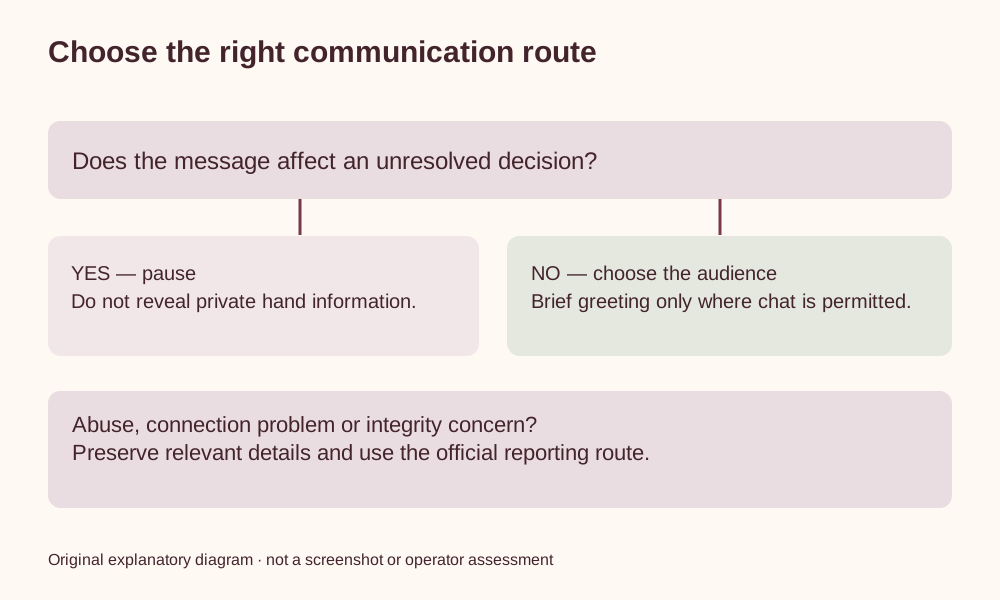
Our proposed default is to avoid commenting on a live hand in a way that reveals private information or influences an unresolved decision. A folded player's observation can still matter to someone who remains involved. A joke about what another participant must be holding may be read as a signal rather than entertainment. Waiting until the action is complete avoids making other people interpret the intention behind the message.
Keep a second boundary in view: private messaging or an external voice call does not make shared information harmless. PokerStars expressly prohibits collusion, describing players working together or sharing knowledge to gain an unfair advantage. The relevant issue is the cooperation, not whether it happened in the visible table chat. This is a conduct principle, not an invitation to speculate about a particular opponent from one unusual result.
Sources: PokerStars cardroom rules.
Do not turn the table into a complaint channel
If an interaction becomes abusive, a public argument often produces more material for everyone else to read without resolving the original problem. Our practical recommendation is to stop the exchange and use the room's reporting or support tools. Record the table or tournament identifier, the approximate time and the precise behaviour you are reporting. Preserve only the information needed for that report; do not publish other players' personal details.
PokerStars' cardroom rules prohibit abusive messages, flooding and harassment, and warn that retaliatory chat can also attract sanctions. That is a useful distinction between reporting conduct and responding in kind. A factual report describes what happened. An accusation about motives, identity or cheating that cannot be substantiated may distract from the evidence the operator can actually investigate.
Sources: PokerStars cardroom rules.
A missing chat feature may be intentional
A disabled chat box is not automatically a technical fault. PokerStars' help page says chat may be disabled during tournaments or all-in hands, and it describes restrictions affecting observers and access to certain table chats. That is a platform-specific explanation; another service may make different choices or use different controls.
Before repeatedly clicking or posting the same message elsewhere, read the current help text for the room and the table type. Our etiquette question is whether a communication is needed at that moment at all. A comment can wait; an account or connection problem belongs with support. Avoid attempting to defeat a restriction through another account or a different channel. The absence of a control does not confer permission to recreate its effect somewhere else.
Sources: PokerStars table-chat help.
Let people use their allotted decision time
Silence or a slow action does not reveal why another player is taking time. The person may be considering the hand, reading an unfamiliar interface or dealing with an interruption. Our recommendation is to avoid pressuring them through chat while the service's own timer governs the decision. Courtesy does not require diagnosing their behaviour from a progress bar.
For your own account, distinguish thinking time from connection protection. PokerStars' cardroom rules expressly say its time bank is not protection against disconnections. Exact timeout behaviour is a matter for the specific product's current rules; do not assume every table will wait or apply the same default action. If a connection is unreliable, use the service's documented options and support route rather than relying on the goodwill of other players to resolve a software state.
Sources: PokerStars cardroom rules.
Study away from a live decision
There is a difference between learning about poker and having a tool choose a live action. PokerStars defines real-time assistance as help from a tool or programme that tells a player how to play and what action to take, and says it is prohibited on its platform. That is a concrete operator policy, not a claim that this article has tested its detection systems or measured enforcement.
Our editorial boundary is straightforward: this page's worksheet classifies communication situations and does not recommend a hand action, analyse an opponent or connect to poker software. Keep educational tools separate from live play and consult the room's current permitted-software rules before using any aid. A tool being freely available, popular or described as educational does not establish permission to run it during a game.
Sources: PokerStars: real-time assistance policy explanation.
Use the scenario cards as a pause before posting
The interactive exercise presents five invented situations: information about a hand still in progress, an abusive message, a routine greeting, a disconnection and a suggestion from outside software. Choosing a card reveals a communication route and the reason for it. There is no score, player profiling or stored chat history. The examples are a way to practise boundaries before a real exchange becomes heated.
For each situation, ask who needs the information. A brief greeting may be appropriate where chat is permitted. A connection problem needs the operator's technical context. A suspected integrity problem needs evidence and an official reporting route. A private card detail generally does not need to be broadcast while someone still has a decision. The right destination is often more important than finding clever wording for the wrong one.
Five invented situations. The answers concern conduct and communication, never how to play a hand.
Courtesy supports integrity, but it does not certify it
The Gambling Commission's RTS 11 addresses measures to deter, prevent and detect collusion and cheating in peer-to-peer gambling within its scope. Such responsibilities sit with the operator and its systems. A polite table cannot by itself demonstrate that those systems are effective, just as an unpleasant message does not establish that a deal was manipulated.
The reader's contribution is narrower and practical: do not share information to obtain an unfair advantage, keep communication respectful, follow the room's current rules and send specific concerns through the appropriate channel. These habits also preserve a clearer record when something needs investigating. They leave the technical judgement to evidence rather than table gossip, and allow ordinary social exchanges to remain ordinary instead of turning every result into a public dispute.
Sources: RTS 11: limiting collusion and cheating.
Questions answered
Should I discuss a hand while other players still have decisions?
The proposed default here is to avoid revealing private information or influencing an unresolved decision. Check the room’s current rules; private channels do not make collusive information-sharing acceptable.
Does a poker time bank protect me from disconnection?
Do not assume it does. PokerStars expressly says its time bank is not disconnection protection. Consult the current rules for the exact platform and table.
Are these chat rules the same on every poker site?
No. The article identifies PokerStars policies as examples from one operator and separates them from its own general recommendations. Features and rules can vary by service and table.