Facts checked Article
Casino equipment
A casino deck is a working object
Card stock, finish and cutting matter as much as the illustration on the back. One maker publishes 3 sizes and up to 12 quality controls per card.
London, 22 September 2026 — the deck is equipment, not decoration
A casino deck is built to be handled for hours inside a closely managed table routine. The illustration on the back is the least load-bearing part of it.
One maker, Fournier, publishes the detail: three card sizes by game, a card-to-card cutting system, and up to 12 quality controls for each card. We read its casino-cards page on 22 September 2026.
For the online reader there is a second document. The RTS — the Gambling Commission’s remote gambling and software technical standards — reach the table too, because RTS 17 covers live dealer studios, and its guidance says equipment and consumables should be of commercial casino quality.
So this piece files three pages in one desk note. Two of them are a maker’s; the third is a regulator’s, and only the third carries a requirement.
Sources: Fournier: casino playing cards; Gambling Commission: RTS 17.
The desk’s five facts
- Three sizes, by game
- Fournier lists 62.5 × 88 mm for poker and blackjack, 57 × 88 mm for kalooky, punto banca and bridge, and 66 × 97 mm for baccarat, chemin de fer and punto banco.Fournier: casino playing cards · as checked on
- Up to 12 checks per card
- Fournier states that each card has to pass up to 12 quality controls throughout the manufacturing process.Fournier: casino playing cards · as checked on
- How the edges are made
- Fournier says its card-to-card die cutting system ensures that all cards are exactly the same size and that the edges are perfectly rounded.Fournier: casino playing cards · as checked on
- 1870, Vitoria
- The brand page places Fournier’s origin in a workshop in the Spanish town of Vitoria in 1870, and describes it as a Cartamundi brand.Cartamundi: the Fournier brand · as checked on
- The online rule
- RTS 17A requires live dealer operations to be fair and independently auditable; the guidance says equipment and consumables should be of commercial casino quality.Gambling Commission: RTS 17 · as checked on
Each line names the page it came from and the date we read it.
More than a printed image: what a casino deck has to do
A casino deck is designed to be handled repeatedly as part of a closely managed table routine. Fournier offers casino cards in both card stock and plastic, and it recommends the fully plastic card for shuffling machines.
Its production account describes printing, varnishing and individual card cutting as distinct stages. Each one contributes to the finished object’s consistency.
So the deck is a manufactured tool before it is a graphic. That is the premise this piece reports from.
In practice that means a casino deck is judged by how it behaves after an hour, not by how it looks in a photograph. Consistency is the property being bought.
Sources: Fournier: casino playing cards.
Vitoria, 1870: where the maker comes from
The brand page gives the origin plainly. Fournier began in a workshop in the Spanish town of Vitoria in 1870, and the page describes Spanish heritage since that year.
It also places the brand inside a larger group. Fournier is a Cartamundi brand, and the page says Cartamundi sells 150 million decks every year.
The page describes an exclusive slow-printing process and a zero-defects guarantee. Those are the maker’s own words, and we report them as claims rather than as findings.
Heritage lines are not findings, though. They tell you how long a company has printed cards, and nothing at all about the deck in front of you tonight.
Sources: Cartamundi: the Fournier brand.
Three sizes, three families of game
The sizes are the clearest evidence that the deck is equipment. Fournier publishes three, and each one is tied to named games.
Poker and blackjack take 62.5 × 88 mm. Kalooky, punto banca and bridge take 57 × 88 mm. Baccarat, chemin de fer and punto banco take 66 × 97 mm.
Those figures are dimensions, not preferences. A dealer’s hands, a shoe and a layout all assume one of them.
Notice that the sizes cluster. For example, poker and blackjack share one figure, while the baccarat family takes the largest of the three.
Sources: Fournier: casino playing cards.
Fournier’s three casino card sizes
| Size (mm) | Games the maker names | Evidence |
|---|---|---|
| 62.5 × 88 | Poker and blackjack | · Fournier: casino playing cards |
| 57 × 88 | Kalooky, punto banca and bridge | · Fournier: casino playing cards |
| 66 × 97 | Baccarat, chemin de fer and punto banco | · Fournier: casino playing cards |
Dimensions are the maker’s own, in millimetres, as printed on its casino-cards page.
Read the material choices
The manufacturer emphasises uniform dimensions, rounded corners and a controlled surface finish. These are useful clues for understanding a casino card as a tool.
Our interpretation is that the deck’s visual design and its physical behaviour should be studied together. The face has to communicate clearly while the object stays manageable in the dealer’s hands.
Fournier also names its stocks: a smooth card stock and an embossed one, alongside the fully plastic card. Each one changes how a deck moves.
Because a casino deck has to be identical card to card, the maker’s emphasis falls on tolerance rather than on pattern. That is an unusual priority for a printed object.
Sources: Fournier: casino playing cards.
Up to 12 controls, a machine eye and a code on the deck
Fournier states that each card has to pass up to 12 quality controls throughout the manufacturing process. That is a claim about process, and it is checkable only against the maker’s own account.
It describes two of the controls. A final print control uses computer vision, which the page calls Intelligent Eye, and a numerical code is printed on each deck for traceability.
It also names the pre-printing technology, listing CtP and offset Heidelberg, and says varnishing uses an exclusive formula handed down for generations.
Sources: Fournier: casino playing cards.
The online table: what RTS 17 asks of the equipment
A live dealer studio deals real cards to an online audience, so the physical deck becomes part of a regulated product. RTS 17 addresses that directly.
Its aim is to ensure that live dealer operations are fair, and requirement 17A states that live dealer operations must be fair and independently auditable.
The implementation guidance names the equipment. It says equipment and consumables should be of commercial casino quality, that designated staff should be responsible for monitoring the integrity of all operational equipment, and that secure areas, gambling equipment and consumables shall be protected by appropriate access controls.
This is the point where a casino deck stops being a supplier’s subject and becomes a regulator’s. A studio in Great Britain answers for its consumables in a way a factory page never does.
The guidance also reaches beyond the cards themselves. It calls for video surveillance to record all dealer activity, and for game logs whose events are collated into statistics.
Sources: Gambling Commission: RTS 17.
The line that reaches the deck
Equipment and consumables should be of commercial casino quality.
Rule or convention: what is actually required
This desk sorts every practice into a rule or a convention. A maker’s process description is neither; it is a claim about one supplier’s factory.
The requirement side is thin and specific. RTS 17 speaks to live dealer studios licensed by the Gambling Commission, and it addresses fairness, auditability, equipment quality, staff monitoring, surveillance and access controls.
Everything else on this page is convention or supplier practice. Saying so is the point of the two columns below.
Sources: Gambling Commission: RTS 17; Fournier: casino playing cards.
Rule, or supplier practice?
| Statement | Rule or supplier practice | Where it comes from | Evidence |
|---|---|---|---|
| Equipment and consumables should be of commercial casino quality | Rule (implementation guidance) | RTS 17A, Gambling Commission | · Gambling Commission: RTS 17 |
| Designated staff monitor the integrity of all operational equipment | Rule (implementation guidance) | RTS 17A, Gambling Commission | · Gambling Commission: RTS 17 |
| Each card passes up to 12 quality controls | Supplier practice | Fournier’s casino-cards page | · Fournier: casino playing cards |
| Cards are cut card-to-card so all are exactly the same size | Supplier practice | Fournier’s casino-cards page | · Fournier: casino playing cards |
| A zero-defects guarantee and a slow-printing process | Supplier claim | The Fournier brand page at Cartamundi | · Cartamundi: the Fournier brand |
‘Rule’ means a published requirement. ‘Supplier practice’ means one manufacturer’s own account of what it does.
How to read an equipment claim without overstating it
The method below is what this desk applied to three pages. It works on any supplier page and any standard.
Each step gives one written line. Five lines is a filed note, and a filed note can be checked by somebody else.
Sources: Fournier: casino playing cards; Gambling Commission: RTS 17.
How to file an equipment claim
Step five says what the result means.
Name the page and the date
Write which page said it and when you read it. A supplier page is a live document and can be rewritten without notice.
Sort it: rule, supplier practice or claim
A requirement in a published standard is a rule. A described process is supplier practice. A guarantee is a claim.
Keep the figure in the unit it was given
Fournier’s sizes are millimetres: 62.5 × 88, 57 × 88 and 66 × 97. Do not convert them into an impression.
Ask what the page does not cover
A supplier describes its own factory. It does not describe which casinos buy the cards, or how often a room changes a deck.
What the result means
You end with a line that says who claimed what, on what date, and in which category. That is enough to quote safely, and it is far less than a promise of security.
Keep claims in proportion
A supplier’s description explains its process. It does not prove that every casino uses the same cards, or replaces them on the same schedule.
Those practices vary. A careful equipment story separates material facts from marketing language and avoids promises about perfect security. The interesting subject is the ordinary craft that supports a readable, consistent table.
A casino deck is also built for long sessions, and so are the rooms that use it. Feeling unable to leave a table is one of the signs GamCare lists. Its helpline is 0808 8020 133, free and open around the clock.
So the honest version is short. A casino deck is well made, on one maker’s account, and well governed in one regulated setting, and neither statement covers every table.
Sources: Fournier: casino playing cards; Cartamundi: the Fournier brand.
The vocabulary desk
Five words carry the argument here, and three of them come off a factory page. We define each one in the sense this piece uses.
The definitions are condensed from the pages read on 22 September 2026. Where a maker or a standard supplies its own wording, we keep it.
Then, because the words here come from two very different kinds of page, each definition names which kind it came from. A factory term and a regulatory term are not interchangeable.
Sources: Fournier: casino playing cards; Gambling Commission: RTS 17.
Words used at this table
- Card stock
- The paper-based material a card is printed on. Fournier lists a smooth stock and an embossed stock alongside a fully plastic card.
- Card-to-card die cutting
- Fournier’s term for the cutting system it says ensures all cards are exactly the same size with perfectly rounded edges.
- Consumables
- In RTS 17’s guidance, the items a studio uses up in play, such as cards. They should be of commercial casino quality and kept under access controls.
- Live dealer studio
- The room where a dealer deals physical cards to an online audience. RTS 17 requires those operations to be fair and independently auditable.
- Traceability code
- The numerical code Fournier says is printed on each deck, which lets a specific deck be identified after it leaves the factory.
Pages read 22 September 2026
Three pages were read on 22 September 2026: Fournier’s casino-cards page, the Fournier brand page at Cartamundi and the Gambling Commission’s RTS 17.
Sources checked 22 September 2026. Each is listed at the foot of this piece with the date it was read.
Supplier pages change more often than standards do. Open them again before quoting a figure from this desk.
Each figure in this desk note was copied from the page rather than from memory. Where a maker or a standard supplies its own wording, we have kept it and marked it as a quotation.
Sources: Fournier: casino playing cards; Cartamundi: the Fournier brand; Gambling Commission: RTS 17.
Questions answered
What size are casino playing cards?
Fournier publishes three sizes. Poker and blackjack take 62.5 × 88 mm, kalooky, punto banca and bridge take 57 × 88 mm, and baccarat, chemin de fer and punto banco take 66 × 97 mm.
Are casino cards plastic or paper?
Fournier offers both. It lists a smooth card stock and an embossed card stock, and a fully plastic card that it recommends for shuffling machines.
How are casino decks checked before they leave the factory?
Fournier states that each card has to pass up to 12 quality controls throughout the manufacturing process, that a final print control uses computer vision it calls Intelligent Eye, and that a numerical code is printed on each deck for traceability.
Do any rules cover the cards used in live online games?
Yes, for studios licensed in Great Britain. RTS 17A requires live dealer operations to be fair and independently auditable, and the implementation guidance says equipment and consumables should be of commercial casino quality and be protected by appropriate access controls.
Does a maker’s process page prove a casino deck is secure?
No. A supplier’s description explains its own process. It does not prove that every casino uses the same cards or replaces them on the same schedule, and this piece makes no promise about perfect security.
References
Continue reading
Why a cardroom keeps chips in view
An orderly chip stack helps a casino poker table remain legible to players, dealers and staff.
Read Why a cardroom keeps chips in view
The posted rules belong to the table
A familiar game name does not remove the need for a clear explanation of the version in front of you.
Read The posted rules belong to the table
Leaving a poker table and returning with less money are different decisions
Five PokerStars help pages separate leaving after a win, same-table returns, buy-in obligations and Seat Me, with their scope differences kept visible.
Read Leaving a poker table and returning with less money are different decisions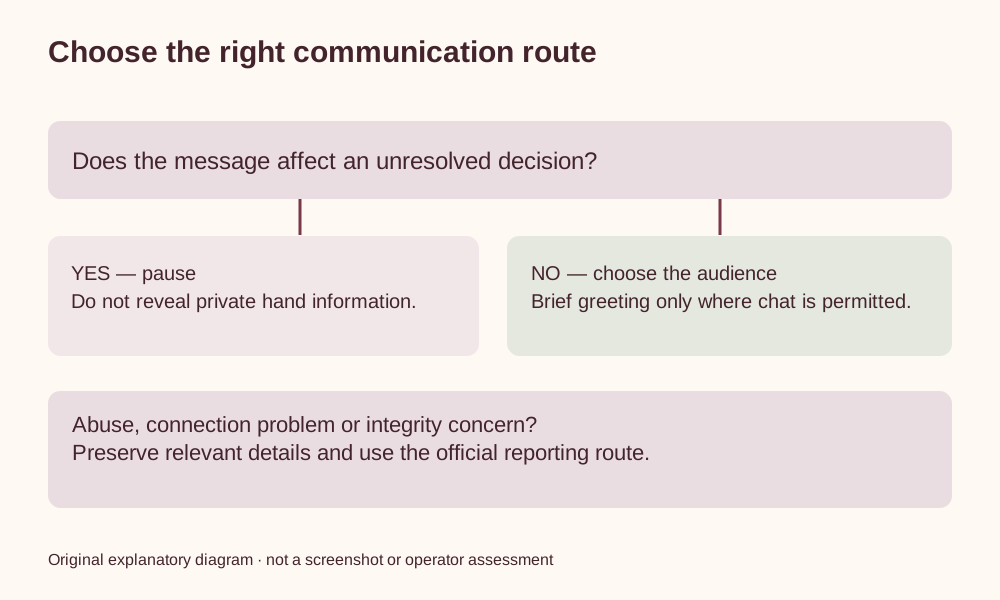
What should you say in an online poker table’s chat?
A practical guide to the social boundaries of an online table: protect live decisions, use the right support channel and leave room for the person behind the screen.
Read What should you say in an online poker table’s chat?
A slow roll is a conduct question before it is a penalty
Compare 888poker’s etiquette writing with its house rules, then separate an observed online delay from an allegation of deliberate humiliation or cheating.
Read A slow roll is a conduct question before it is a penalty
What is slow rolling poker: what the posted rules say and what players merely expect
A slow roll is delaying the reveal of a winning hand at showdown after an opponent has shown. The 888poker etiquette guide calls it 'highly unethical'; the 888poker house rules and the 2026 World Series of Poker tournament rules do not name it at all. This piece reads all three, separates the slow roll from ordinary slow play, and sorts each behaviour into rule or convention.
Read What is slow rolling poker: what the posted rules say and what players merely expect
Continue reading
What is slow rolling poker: what the posted rules say and what players merely expect
A slow roll is delaying the reveal of a winning hand at showdown after an opponent has shown. The 888poker etiquette guide calls it 'highly unethical'; the 888poker house rules and the 2026 World Series of Poker tournament rules do not name it at all. This piece reads all three, separates the slow roll from ordinary slow play, and sorts each behaviour into rule or convention.
Read What is slow rolling poker: what the posted rules say and what players merely expectLeaving a poker table and returning with less money are different decisions
Five PokerStars help pages separate leaving after a win, same-table returns, buy-in obligations and Seat Me, with their scope differences kept visible.
Read Leaving a poker table and returning with less money are different decisionsA slow roll is a conduct question before it is a penalty
Compare 888poker’s etiquette writing with its house rules, then separate an observed online delay from an allegation of deliberate humiliation or cheating.
Read A slow roll is a conduct question before it is a penaltyWhy a cardroom keeps chips in view
The posted rules belong to the table
Online poker etiquette is not written down
Leaving a poker table and returning with less money are different decisions
What should you say in an online poker table’s chat?
A slow roll is a conduct question before it is a penalty
What is slow rolling poker: what the posted rules say and what players merely expect