Table conduct
Online poker etiquette is not written down
A house rules page and a "poker etiquette" article usually sit on the same operator's own site. Read side by side, they draw a clear line between what gets you banned and what just gets you disliked.
Two different things get called "the rules"
A forum thread on poker etiquette will tell you slow rolling is "against the rules" in the same sentence as it tells you collusion is against the rules. They are not the same kind of statement. One describes a clause an operator has published, with a consequence attached if you break it. The other describes a shared expectation that nobody administers.
The test this article uses is simple and repeatable: find the operator's own published rules page, and check whether the behaviour appears there with a named consequence. If it does not, it may still be a strong convention — worth following, since a table's goodwill matters — but it is not a rule, and treating it as one misdescribes what actually happens if you break it.
888poker turns out to be a convenient case study, because it publishes both kinds of page on its own site: a formal House Rules page, and a separate "poker etiquette" article in its strategy magazine. Reading them side by side does the sorting for you.
What an operator's rule page actually prohibits
888poker's House Rules describe a non-collusion policy: "Collusion exists when two or more players at a Poker table attempt to gain an unfair advantage by sharing knowledge of their cards or other information. Collusion will not be tolerated." A separate chat-conduct clause states that "intimidation or harassment of other players at the table will not be tolerated" and asks players not to "engage in 'shouting matches' with other players at the table." A general fair-play clause goes further still: play in "an unethical manner, or not adhering to stated or unstated rules of play," can lead to winnings being confiscated, the account cancelled and the player permanently banned.
That last clause is worth noting for what it does, not just what it says: it gives the operator broad discretion to act on conduct it has not spelled out in advance, which is a real enforcement power, even though it is worded loosely. It differs from a convention precisely because a specific consequence — confiscation, cancellation, a ban — is attached to it in the operator's own text.
Live tournament poker publishes the same kind of thing in more granular form. The World Series of Poker's official tournament rules state, under general conduct, that "all Participants are entitled to expect civility and courtesy from one another at every table," and separately define a string bet as "attempting a bet or raise in multiple movements that include a return to a Participant's stack without a prior verbal declaration of intent," a defined offence with penalties available under three further numbered rules. Acting out of turn is addressed by name too: a verbal declaration made in turn is binding, and intentionally acting out of turn to influence other players can draw a penalty.
Sources: 888poker House Rules · World Series of Poker: 2026 Official Tournament Rules.
The same operator's own etiquette advice is not a rule
888poker's magazine carries a separate article headed "Poker Etiquette: 30 Unwritten Rules Everyone Needs To Follow." The title does the honest thing and names the category: unwritten. It calls slow rolling — deliberately delaying the reveal of a winning hand after an opponent has already shown theirs — "highly unethical." It tells players not to "hit and run," meaning leaving the table shortly after winning a large pot from someone. It advises against typing in capital letters, because it "constantly" reads as anger and is "somewhat annoying and disruptive." It discourages needling other players about hands they have already played.
None of that appears in the House Rules page, and none of it carries a stated penalty anywhere on the operator's site. That is not a contradiction between the two pages; it is the operator drawing its own line between conduct it will act on and conduct it will merely disapprove of in an advice column. The strong language — "highly unethical" — belongs to the second category, which is worth remembering the next time a strategy article's wording is mistaken for a rules page's wording.
The artefact below sorts six concrete examples from these two 888poker pages and the WSOP rules into the two columns, with the exact source and, where one exists, the stated consequence.
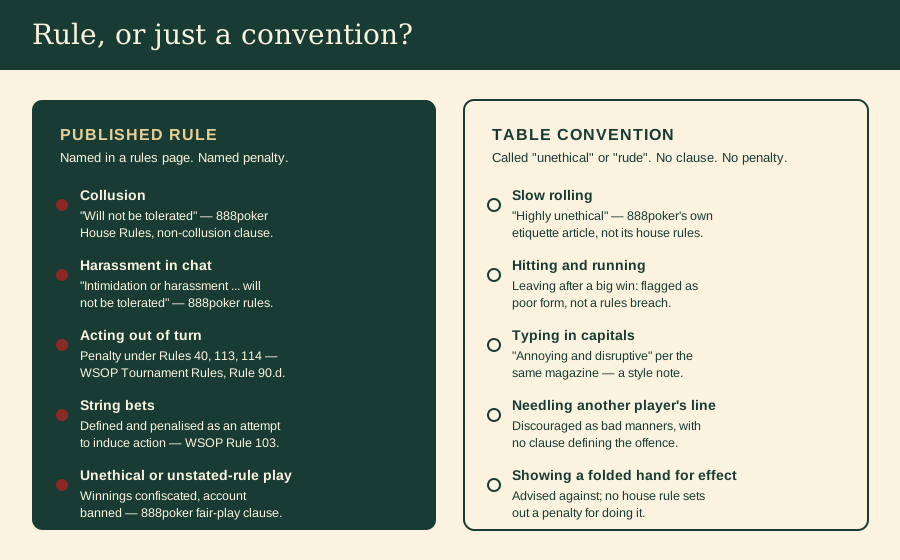
| Behaviour | Category | Source and date | Stated consequence |
|---|---|---|---|
| Sharing card or hand knowledge between players (collusion) | Rule | 888poker House Rules, non-collusion clause — accessed 19 September 2026 | Named as not tolerated; falls under the operator's ban authority |
| Intimidation or harassment in chat | Rule | 888poker House Rules, table etiquette clause — accessed 19 September 2026 | Named as not tolerated |
| Acting out of turn to influence other players | Rule | WSOP 2026 Official Tournament Rules, Rule 90.d — accessed 19 September 2026 | Penalty available under Rules 40, 113 and 114 |
| A string bet (a raise made in separate motions without declaring it first) | Rule | WSOP 2026 Official Tournament Rules, Rule 103 — accessed 19 September 2026 | Treated as a defined violation with penalty provisions |
| Slow rolling a winning hand at showdown | Convention | 888poker magazine, "Poker Etiquette: 30 Unwritten Rules" — accessed 19 September 2026 | None stated; called "highly unethical" in an advice article, not the House Rules |
| "Hitting and running" after winning a big pot | Convention | 888poker magazine, "Poker Etiquette: 30 Unwritten Rules" — accessed 19 September 2026 | None stated; described as poor form only |
Is slow rolling against the rules?
Not on the evidence checked here. 888poker's own House Rules page has no clause addressing slow rolling; the condemnation lives entirely in its separate strategy-magazine article, which explicitly frames the whole list as unwritten. The WSOP's tournament rules do not contain a titled slow-rolling provision either. Their nearest neighbour is a rule about a player deliberately miscalling their own hand at showdown, which is a different act — announcing the wrong hand, rather than correctly announcing it late — and it would be a stretch to treat the two as the same offence.
That does not make slow rolling harmless to do. It is one of the most reliably resented moves at a poker table, live or online, precisely because it looks deliberate: the winning player already knows the result and chooses to make the loser wait. But "reliably resented" and "against the rules" are different claims, and only one of them is currently backed by an operator's published text.
Hitting and running: rude, not banned
The same applies to leaving a cash table soon after winning a substantial pot from a specific opponent. 888poker's etiquette article names it directly and disapproves of it. Nothing in the House Rules sets a minimum time at the table, a cooling-off period after a big win, or any penalty for leaving whenever a player chooses. The WSOP rules do not bear on this at all in the way often assumed, since they govern tournament structure rather than a cash game a player can leave freely once a hand is finished.
So: is it rude to leave a poker table after winning? By the convention this article can actually source, yes, particularly if it happens immediately after taking a specific opponent's stack — it reads as playing for the result rather than the game. Is it against any rule this article found on a licensed operator's own page? No. Treat it as a courtesy call, not a compliance question, and decide accordingly; nobody is going to confiscate the win.
Chat, collusion and the line RTS 11 draws
The UK Gambling Commission's remote gambling and software technical standard RTS 11 requires operators running peer-to-peer games such as poker to implement measures that "deter, prevent, and detect" collusion and cheating, and to disclose their policies on cheating, recovered funds and how a customer can complain if they suspect other participants of cheating. That is a regulatory requirement aimed at a specific harm — players cooperating against other players for unfair advantage — not a code of table manners.
888poker's own collusion and chat-harassment clauses sit comfortably inside that requirement: they describe exactly the kind of conduct RTS 11 exists to catch, and they attach a real consequence. Typing in capitals, by contrast, sits nowhere near RTS 11's subject matter; it is a readability complaint dressed up as an etiquette rule, and no regulatory or operator text treats it as anything else. Cardroom Journal has covered the finer live-decision boundaries of online table chat — what to say and when to stay quiet while a hand is still live — in a separate, more detailed piece; this section only establishes which end of that spectrum a regulator actually polices.
Sources: UK Gambling Commission: RTS 11 — limiting collusion and cheating · 888poker House Rules.
String bets and acting in turn belong to the live table
String bets and acting out of turn are worth a separate note because they are genuinely procedural rules, not conventions dressed up as rules — and yet an online player will rarely encounter either. A string bet exists because a physical chip movement can be ambiguous: does returning to the stack mean the raise is still being assembled, or does it signal more is coming? A tournament floor has to rule on that ambiguity in real time, which is why the WSOP rules define it so precisely.
An online table's bet slider or fixed-increment buttons remove the ambiguity by construction: a wager is either submitted or it is not, and the interface generally will not let a player act before their seat is live. That is a genuine difference in how the same underlying rule gets enforced, not evidence that the rule has disappeared online — it has simply been designed around at the interface layer, which is a subject Felt & Form covers in more depth on the screen side of this split.
Source: World Series of Poker: 2026 Official Tournament Rules, Rules 90.d and 103.
Read the room's actual rules before you sit down
The method this article uses is worth stating plainly, because it works for any room and any list of "rules" circulating online. First, find the operator's own published rules or terms page — not a strategy blog, not a forum thread — and read the clauses on conduct, chat and fair play directly. Second, note whether a specific consequence is attached to each one; if it names a penalty, a ban, or confiscation, treat it as a rule. Third, check separately whether the same operator, or anyone else, has also published etiquette or strategy advice using stronger moral language than the rules page does; if so, that stronger language usually marks a convention, not a stricter version of the rule.
Applied here, that method produced a short, checkable list rather than a vibe: collusion, harassment and confirmed cheating are rules with teeth; slow rolling, hitting and running, and shouting in capitals are strongly felt conventions with none. Both categories matter to how a table actually feels to play at. Only one of them will get an account closed.
References
- 888poker House Rules — accessed 19 September 2026
- 888poker: Poker Etiquette — 30 Unwritten Rules Everyone Needs To Follow — accessed 19 September 2026
- World Series of Poker: 2026 Official Tournament Rules — accessed 19 September 2026
- UK Gambling Commission: RTS 11 — limiting collusion and cheating — accessed 19 September 2026
- Upswing Poker glossary: the 7-2 Game — accessed 19 September 2026
- GTO Wizard: Using the 80/20 Rule in Poker — accessed 19 September 2026, cited only as an example of informal usage, not as an operator or regulatory source