
Poker room culture
Leaving a poker table and returning with less money are different decisions
Five PokerStars help pages separate leaving after a win, same-table returns, buy-in obligations and Seat Me, with their scope differences kept visible.

You do not owe the table another session
PokerStars' cash-game help says players may leave whenever they want. Its separate Hit & Run page calls joining with a minimum buy-in and departing after a winning pot bad manners, rather than a rules breach. Those statements distinguish a social judgement about leaving from an enforceable condition governing what happens next.
You do not need to keep gambling to repair someone else's opinion of your departure. If you have decided to stop, stop. The practical complication is re-entry: another table, the same table or an automatically assigned pool may carry rules that are not captured by the sentence about being free to leave.
This is a documentary comparison of five public English-language PokerStars help pages fetched on 19 September 2026. No account was opened, no table was joined and no warning was triggered. The pages do not establish one uniform rule for every jurisdiction or account. Where their scope differs, the difference is retained below instead of being silently resolved into a universal policy.
Sources: Cash games; Hit & Run rules.
The return can be treated as part of the same sitting
The page titled Removing funds from a cash game table says that returning to the same table within 120 minutes in high-stakes Pot Limit or No Limit poker counts as the same session. It describes returning with the amount previously held, or up to 10% less where that is all the player has in the bankroll. It excludes Play Money, Zoom and Fixed Limit games.
That is a condition on returning in a specified setting. It is not a demand that someone remain seated until other players recover their losses. It also cannot be applied to an unrelated product merely because both involve poker. The words same table, high-stakes and the excluded formats belong beside the 120-minute figure whenever the rule is summarised.
For a reader's note, record the table identifier, game type, stakes, departure time and stack. Those fields are more useful than an argument about whether the departure looked polite. They locate the event within the published rule. This article does not establish the operator's definition of high-stakes or verify how any particular account's return amount would be calculated.
Sources: Removing funds from a cash game table.
Two help pages do not quite say the same thing
The Hit & Run page also refers to a return within 120 minutes and says its policy applies to Pot Limit and No Limit games. Unlike the Removing funds page, it does not state the high-stakes limitation in the passage checked. Its sentence about the 10% exception is less clear than the separate page's description of up to 10% less.
These are meaningful documentary differences. We use the more explicit Removing funds page when describing its narrowly stated rule, but do not claim that one page formally overrides the other. No account-specific ruling or operator clarification was obtained. A reader whose intended return falls near the boundary should ask which policy applies to the exact product and account.
This is where a rules article earns its space. Repeating one number without its scope would be shorter, but would conceal the uncertainty. The evidence supports saying that the two pages differ. It does not support declaring that every No Limit table uses one universal 120-minute rule, or that the exception is permission to return with only a tenth of the previous stack.
Sources: Hit & Run rules; Removing funds from a cash game table.
Repeated movement creates a separate question
The Buy-in obligations page describes a higher minimum after repeated departures with winnings followed by rejoining with smaller stacks. It states high-stakes No Limit and Pot Limit cash tables and all Zoom tables as its scope. The published thresholds are eight re-entries in a twenty-hour period for regular cash tables and four for Zoom before the limit is exceeded.
It also groups the affected tables by their buy-in range measured in big blinds. That is a different organising principle from the same-table return rule. A player can therefore need an answer about a group of tables even where the next table has a different identifier. The document describes the feature as a way of discouraging repeated movement and reducing table breaking.
The distinction is procedural, not a suggestion to map out the most frequent movement permitted. A record of a repeated-movement restriction should state its product and period. It should not turn into a schedule for avoiding the rule. If a larger minimum is unsuitable, the sensible response is not to put more money at risk merely to regain a seat.
Sources: Buy-in obligations.
Seat Me introduces another stated condition
The Seat-me explanation describes an automatic seating system for cash games. Its leaving-early section says that at the specified stakes, $0.05/$0.10 or higher, leaving or sitting out before ten hands can result in a temporary restriction on joining other cash games. It describes a warning and increasing consequences for repeated early departures, and excludes Zoom, Sit & Go, Spin & Go and multi-table tournaments from that rule.
This public page is not proof that Seat Me is enabled for every UK reader. It is evidence that a product-specific early-departure condition exists in the operator's documentation. Its consequence concerns new entries; the page does not describe preventing someone from stopping gambling altogether. Do not reinterpret it as a duty to continue playing ten hands against your decision to leave.
A useful clarification would ask whether the warning concerns Seat Me, a same-table return or a buy-in obligation. Those are three named mechanisms with different triggers. Asking which mechanism generated the message gives support a concrete question; asking whether leaving is allowed may produce an answer too general to resolve the situation.
Sources: Seat-me explanation.
Three fictional departures, three different records
First consider a person who leaves after a win and makes no attempt to return. The event to record is the departure. Another player's annoyance supplies no extra obligation to keep gambling. The general cash-game and Hit & Run pages explain why a social label should not automatically be rewritten as an accusation of breaking a rule.
Second, imagine a person returning to the same high-stakes No Limit table after one hour, having left with 150 units and now proposing to bring 100. Under the explicit Removing funds page, the return falls within its stated 120-minute window. A 10% reduction from 150 would be 15, leaving 135, and even that exception is conditional on the bankroll statement. This is arithmetic applied to an invented example, not an account decision.
Third, imagine a warning that mentions early departure in a Seat Me cash game. The relevant evidence includes that product label, the applicable stakes and hands completed. Copying the 120-minute number into the response would not answer the warning's stated trigger. The same is true of copying the repeated-movement threshold without establishing that a buy-in obligation is involved.
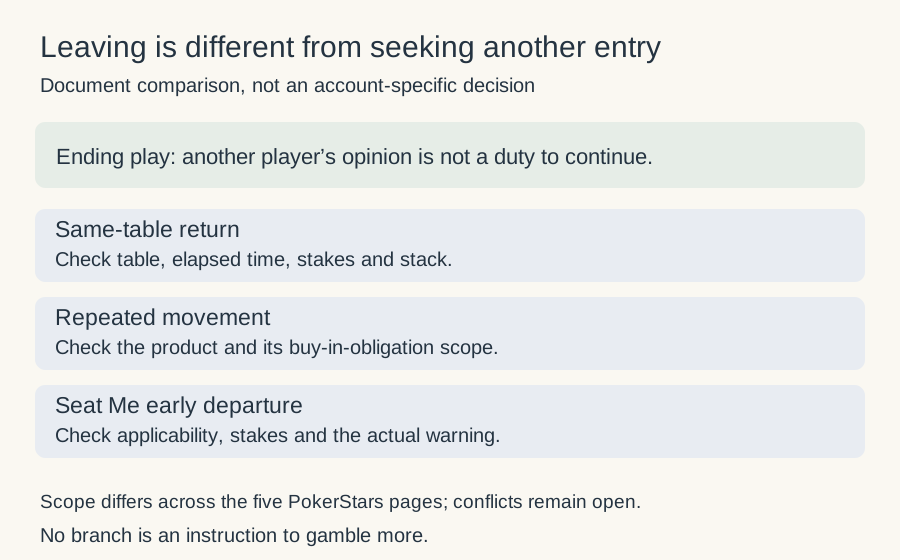
The figure separates these paths rather than merging them into one flowchart that promises an outcome. It starts with the question whether the person is ending play or seeking another entry. Once re-entry is involved, the appropriate branch depends on the actual product and rule. Unknown applicability stays unknown; no branch instructs someone to gamble more.
Sources: Cash games; Removing funds from a cash game table; Buy-in obligations; Seat-me explanation.
Courtesy can be brief and non-negotiable
A departure need not become a debate about the next player's chance to win money back. If you choose to say anything, a short statement that you are finishing is sufficient. That is this journal's editorial advice, not a quoted operator rule. You do not need to disclose personal finances, your timetable or the reason you are stopping to justify the decision in chat.
For the person remaining at the table, keep a complaint about a suspected rules issue factual. Identify the table and event privately through the appropriate support route. A public accusation adds heat without establishing which policy applies. Describing a departure as rude and demonstrating a re-entry breach require different evidence.
This distinction also protects the quality of a written account. If a report says a player left with a winning stack, it describes an observable sequence. If it says the player evaded a buy-in restriction, it needs the later entry and the applicable rule. The first statement should not be used as a shortcut to the second.
Sources: Hit & Run rules; Cash games.
Keep the scope attached to the rule
Before relying on a saved explanation, check the named product, current page and account context. The five pages reviewed here provide a starting vocabulary: cash-game departure, same-table return, repeated buy-in obligations and Seat Me early-departure restrictions. They are not interchangeable synonyms for hitting and running.
The unresolved points are specific. The fetched documents do not settle their differing high-stakes wording, prove which features apply to a UK account, or tell us what an actual warning would say for a particular player. Those gaps are recorded rather than filled with a supposed universal cardroom custom.
The broader etiquette lesson is practical: respect someone else's decision to stop, and read a re-entry condition as a re-entry condition. A table's social expectations can explain why people react, but the relevant written rule is what defines the procedure. Neither is a reason to continue risking money simply to make a departure look more agreeable.
Sources: Removing funds from a cash game table; Buy-in obligations; Seat-me explanation.
Questions answered
Is it rude to leave a poker table after winning?
PokerStars' Hit & Run page describes a particular minimum-buy-in departure as bad manners rather than a rules breach. That social description does not create an obligation to continue gambling; re-entry conditions are a separate question.
Can I join and leave at any time?
The general cash-game page says yes, but the other reviewed pages describe conditions on subsequent entries in specified products. Stopping a session and securing another seat are different actions.
What are buy-in obligations?
PokerStars describes higher minimums triggered by repeated departures and returns with smaller stacks in the stated cash-game and Zoom scope. Check the current product rules rather than treating this as the same mechanism as a same-table return.
Does the 120-minute return rule apply to Zoom?
The Removing funds page expressly excludes Zoom from that same-table rule. A separate Buy-in obligations page includes Zoom, so exemption from one condition does not establish exemption from every re-entry condition.
Must I keep playing if Seat Me warns me about leaving early?
The reviewed page describes a temporary restriction on entering other cash games, not an obligation to continue gambling. Its applicability to a particular account was not tested; stop when you need to and clarify any later re-entry restriction separately.